Trenchbox Shoring
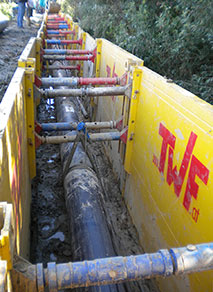
GeneralThe TWF trench boxes are a mechanised trench shoring system for nearly all sites and ground conditions and offer maximum performance in depths from 2-4 m. The trench boxes are manipulated, installed and extracted by a hydraulic backhoe excavator of 20-30 tons operating weight. Shoring plates are available in various lengths and heights for trench depths up to 6200 mm (depending on ground conditions). The standard sizes of different trench box systems as well as the clear head room below the bottom strut are as follows:
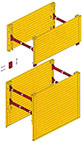
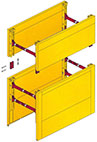
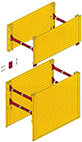
Main parts:One trench box consists of following main parts:
Advantages:The TWF trench boxes offer following main advantages:
Part Details:
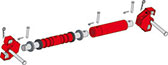
The box plates are made either of steel profiles or as sandwich construction with a reinforced top section and a cutting edge at the bottom. Two vertical C-sections at both ends of the plate house the spindle units (consisting of the threaded spindle and two mushroom fittings with springs) which are locked in position by steel pins and secured by safety clips. The mushroom fitting limits the spindle to swivel vertically for +/- 8 degrees allowing the independent movement of the plates during installation and extraction without damage. Assembling:Every project starts with the assembling of the trench box. The spindles are adjusted to the required trench width and sled with the mushroom fitting into the C-profile of the plate. After locking the spindle into position by the pin and securing the pin by the spring clip the two springs of the mushroom fittings are released which holds the plates always in a 90 degree position when the box stands on the ground. After assembling the trench box the spindle length should be fine-tuned to the requested trench width whereby the bottom of the trench box has to be 20 to 30 mm (depending on the soil condition) wider than the top for easier installation and extraction. Installation:Trench boxes are installed by one hydraulic backhoe excavator and two men during excavation using the lower-and-cut method. After making a first cut of 1-1.5 m depth (depending on the soil stability) the trench box is lifted by the excavator into the trench by a 4-leg steel rope or chain. The excavator cuts with the bucket along the box plates and pushes them down with the full bucket alternating on both sides until the necessary depth is reached. If more depth is needed the trench box can be extended by a trench box top which has to be fixed to the base by 4 plate connectors (each having two bolts with safety clips). To avoid any damage of the plate top when pushing with the bucket the use of heavy duty plate protectors is strongly recommended. The work continues in the same way. After a small first cut the next trench box is lifted into the trench and sunken down as described before. If the excavator pushes the new box gently to the already installed one any gap between the boxes can be reduced to a minimum. Extraction:After pipe laying the trench boxes can be extracted by the excavator whereby the compaction instructions have to be observed. It is recommended to place the backfill material at first, then to lift the trench box and to compact the backfill in layers against the nature ground avoiding any ground settlements to a minimum. Safety:Please observe the following carefully (this is not a complete listening):
|